10+ CSS Blob Effects: Free Code Snippets & UI Examples
CSS blob effects introduce organic, morphing geometry into modern web design, breaking away from rigid grid constraints to establish a more fluid and engaging visual rhythm. By leveraging native browser APIs, developers can simulate physical surface tension and fluid dynamics without the overhead of heavy WebGL contexts.
- Complex shape interpolation is frequently achieved using dynamic border-radius manipulation, layering multiple percentage values (e.g.,
50% 50% 20% 80%) to calculate non-uniform spatial constraints. - Advanced fluid interactions mimic true liquid cohesion by merging adjacent DOM elements via an SVG feColorMatrix alpha-channel thresholding technique applied over a Gaussian blur.
- Continuous morphing animations are strictly constrained to the compositor thread using transform matrices and scale properties, completely bypassing main-thread layout recalculations.
Analyze these procedural geometry patterns to seamlessly integrate natural, physics-inspired aesthetics into your architectural workflow.
Table of Contents:
Examples

Morphing Blob Image Carousel
This is a Morphing Blob Image Carousel. It utilizes procedural geometry and GSAP to generate a continuously shifting SVG mask over an image slider. Its function is to break the rigid, rectangular grid of standard web layouts. The organic motion draws the eye, making the standard act of cycling through images feel fluid and tactile. (Requires: gsap.js)
 Chrome 60+
 Edge 79+
 Firefox 55+
 Safari 11.1+
See the Pen Morphing Blob Image Carousel.
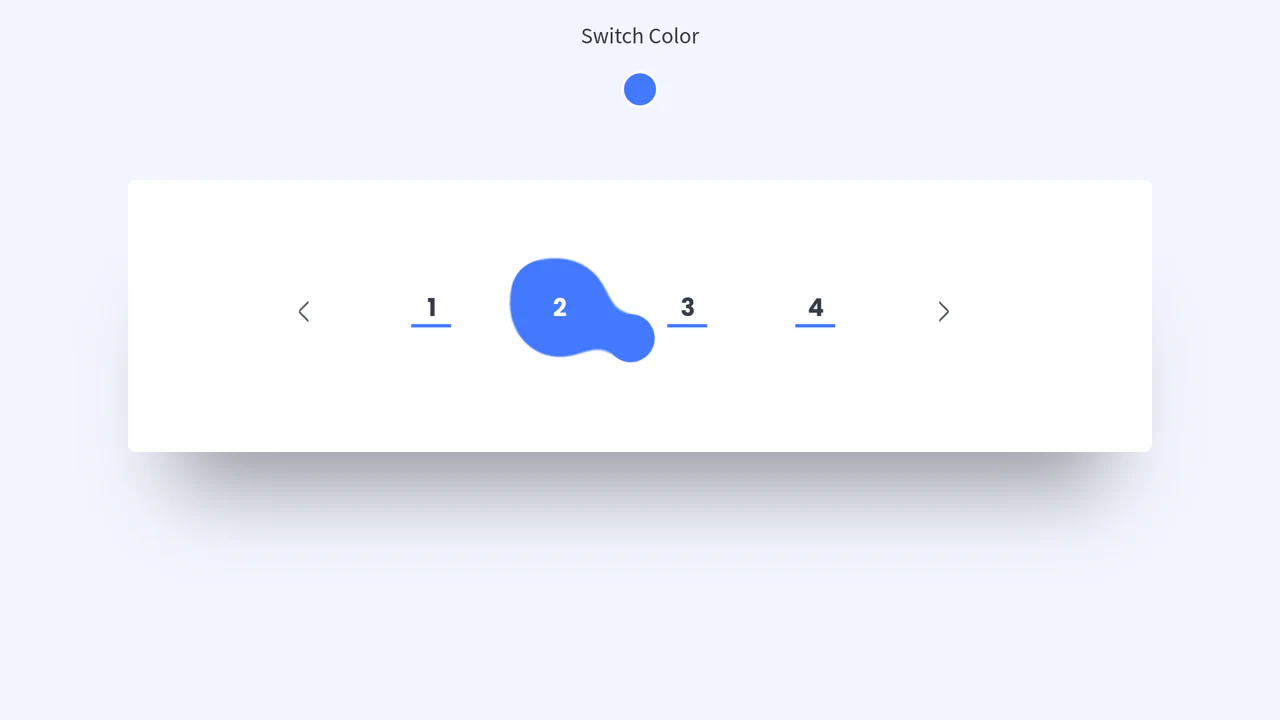
Pagination Liquid Blob Menu with CSS and Audio
The “liquid” pagination effect is fully implemented via pure CSS animation, using pseudo-elements and border-radius: 50% to create the dynamic “blob.” Vanilla JavaScript is responsible for precise active element positioning by calculating offsetLeft on click.
See the Pen Pagination Liquid Blob Menu with CSS and Audio.

Unlock modern web interactivity with CSS Scroll-Driven Animations, seamlessly linking scroll position to reveal effects for lightweight, high-performance visual storytelling without relying on complex JavaScript libraries.
This organic blob component utilizes a gooey SVG filter to synthesize fluid, liquid-like adhesion between oscillating DOM elements. Technical implementation leverages JavaScript to orchestrate manual coordinate updates, while CSS handles the parametric path generation to maintain high-performance visual morphing on the GPU. The interaction creates a tactile, cohesive sensation of viscosity that prioritizes fluid responsiveness and immersive depth.
This fluid organic component utilizes will-change properties to synchronize border-radius morphing with GPU-accelerated spatial transforms. Technical implementation relies on declarative keyframes and layered pseudo-elements to create a rhythmic, liquid-like pulsation. The interaction delivers an immersive, visceral sense of elasticity that prioritizes high-fidelity motion and visual fluidity.
This cursor-tracking component leverages mix-blend-mode to enact a reactive, color-shifting overlay that responds to spatial input. Technical implementation relies on JavaScript to synchronize DOM coordinates with GPU-accelerated border-radius morphing and gradient transitions. The interaction provides a fluid, high-fidelity feedback loop, turning user navigation into a rhythmic, visually immersive experience.
This organic frame employs a morph keyframe animation to continuously interpolate border-radius values, creating a fluid, living container for imagery. Technical implementation offloads geometry recalculations to the GPU, ensuring jitter-free execution without layout thrashing. The interaction delivers a hypnotic, rhythmic pulsation that prioritizes visual softness and performance-oriented design.
This motion-reactive component uses orchestrated keyframes to execute a non-linear physics simulation of an elastic sphere. Technical implementation leverages transform properties and border-radius morphing, offloading high-frequency re-renders to the GPU to maintain fluid motion. The interaction provides a tactile, rhythmic sense of kinetic energy, prioritizing physical responsiveness and performant execution.
An Animated Blobby Gooey Button
This vector-morphing component uses SVG path interpolation to create a living, breathing container that reacts to subtle hover states. Technical implementation relies on declarative CSS keyframes to toggle coordinate data, while mask definitions carve typography out of the geometry to ensure visual depth. The interaction distills complex motion into a focused, fluid reveal that prioritizes performant, high-fidelity rendering.
See the Pen An Animated Blobby Gooey Button.
This procedural blob component utilizes a complex border-radius keyframe interpolation system to achieve a fluid, morphing silhouette. Technical implementation leverages mix-blend-mode: multiply on internal imagery to harmonize color, while offloading all geometric morphing to the GPU for jitter-free performance. The interaction produces a rhythmic, breathing effect that prioritizes visual softness and performance-oriented design.
This grid-based UI component utilizes CSS grid layout and transition delays to create a responsive, playful interface. Technical implementation offloads spatial positioning to the browser’s compositor, using CSS variables and pseudo-classes to orchestrate harmonious, multi-state hover interactions. The result is a crisp, rhythmic grid that prioritizes structural modularity and engagement.
This ambient background component uses filter: blur() and synchronized keyframes to orchestrate fluid, undulating geometric morphing. Technical implementation leverages preserve-3d stacks and GPU-accelerated transforms to ensure performant motion, creating a rhythmic, hypnotic sense of depth that prioritizes visual softness and focus.
This glassmorphism card component utilizes backdrop-filter for spatial depth, complemented by a GPU-accelerated blob background. Technical implementation relies on declarative keyframes and mix-blend-mode to orchestrate fluid, morphing silhouettes, offloading rendering to the compositor for smooth performance. This creates a tactile, immersive environment where light and movement prioritize focus.

This tactile neomorphic component leverages complex box-shadow layering and pseudo-element masking to simulate physical volume and depth. Technical implementation utilizes declarative border-radius shaping and static coordinate positioning to offload rendering to the browser’s compositor for efficient GPU compositing. The interaction distills static form into a soft, light-reactive surface, prioritizing high-fidelity material realism.
RGB Blob Preloader
A hypnotic blob loader built with pure CSS, utilizing mix-blend-mode: screen for organic RGB color blending. This snippet showcases advanced border-radius manipulation to create fluid, liquid-like motion, ensuring high frontend performance with zero JavaScript dependencies.
See the Pen RGB Blob Preloader.
This toggle component utilizes mix-blend-mode: darken and high-contrast radial-gradient masks to create a fluid, tactile switch mechanism. Technical implementation leverages CSS custom properties for state-dependent scaling and cubic-bezier padding transitions, ensuring performance-optimized rendering on the GPU. The interaction delivers a crisp, rhythmic feedback loop that prioritizes physical-like surface responsiveness and geometric clarity.
These kinetic loaders utilize filter: blur() contrast() to synthesize viscous, liquid-like motion from basic radial-gradient primitives. The implementation offloads complex paint operations to the GPU, orchestrating rhythmic background position shifts via keyframes to achieve seamless, high-performance animation. This interaction produces a tactile, hypnotic cycle that prioritizes structural fluidness and visual weight.
This dynamic morphing component utilizes JavaScript to generate parametric border-radius coordinates, creating fluid, organic shapes. Implementation relies on CSS variables and transition properties to sync GPU-accelerated transforms, ensuring a smooth, tactile deformation. The interaction distills complex geometry into a reactive, user-driven experience that prioritizes visual fluidity and performance.
This visual synthesis component employs a high-contrast blur and contrast filter stack to create a visceral, viscous fluid interaction. Technical implementation relies on declarative keyframes and mix-blend-mode to orchestrate rhythmic motion within a masked environment, offloading complex layering to the GPU. The result is a hypnotic, multi-layered unveiling that prioritizes material fluidity and performance.