10+ CSS Credit Cards: Free Code Snippets & Examples
Payment form design directly impacts conversion rates, and interactive credit card previews bridge the gap between abstract input fields and a tangible payment method. CSS credit card components render realistic card visuals that update in real-time as the user types, building trust through immediate visual feedback.
- Each card is rendered with semantic HTML elements — card number, expiry, and CVV — so the text remains selectable, indexable by search engines, and readable by screen readers without relying on canvas or image-based fallbacks.
- The 3D flip animation uses
transform: rotateY()withbackface-visibility: hidden, operating entirely on the GPU compositor thread to maintain consistent frame rates even during rapid form interactions. - Responsive scaling relies on
clamp()functions and Container Queries, allowing the card preview to shrink proportionally within narrow checkout sidebars without breaking the card chip or logo alignment.
Browse the collection to find a credit card style that matches your checkout flow — from minimal flat designs with dynamic gradient backgrounds to skeuomorphic embossed cards with chip reflections.
Table of Contents:
Examples
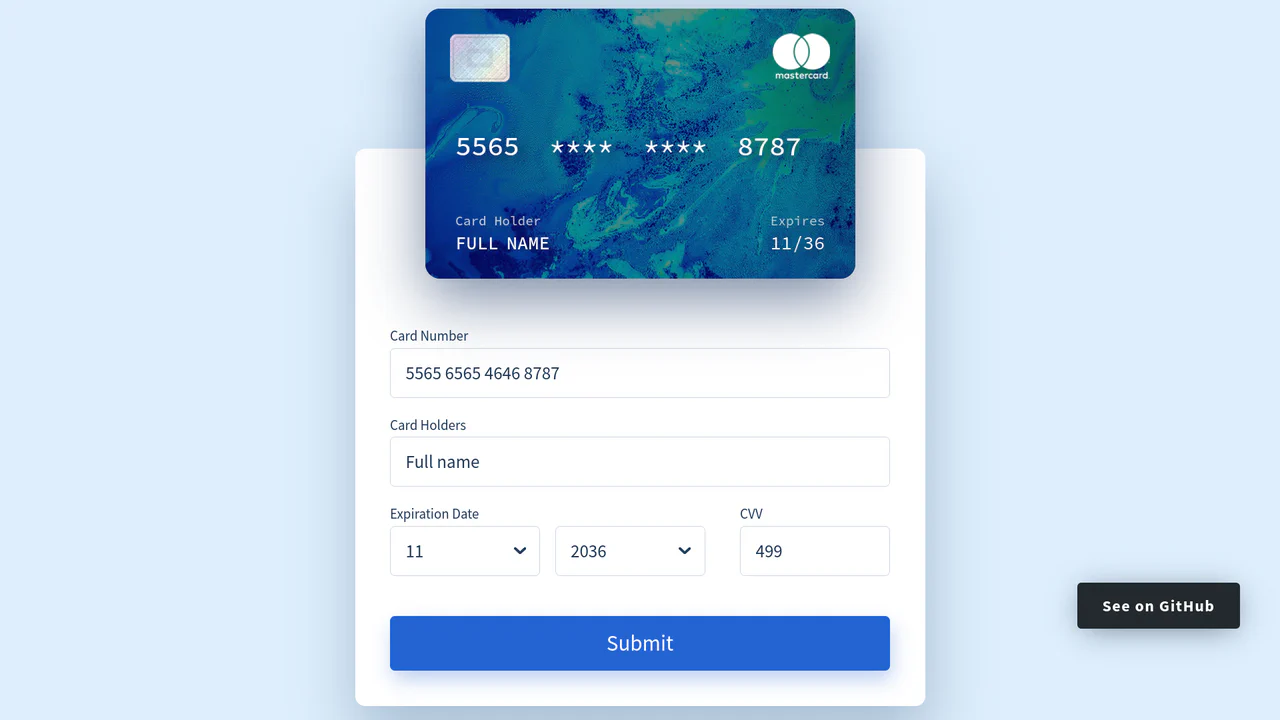
Interactive 3D Credit Card Form
An interactive credit card checkout form built with Vue.js. As users type into the input fields, the data is masked and mirrored in real-time onto a virtual 3D credit card. Focusing on different inputs triggers a dynamic highlight box that glides across the card’s surface, while entering the CVV field smoothly flips the card 180 degrees using CSS preserve-3d and backface-visibility. (Requires: vue.js)
 Chrome 49+
 Edge 12+
 Firefox 49+
 Safari 9.1+
See the Pen Interactive 3D Credit Card Form.
Virtual Credit Card UI
A demonstration of “living” cards with two looped @keyframes animations - one for smooth background panning, and another for creating a shimmering gradient highlight.
See the Pen Virtual Credit Card UI.
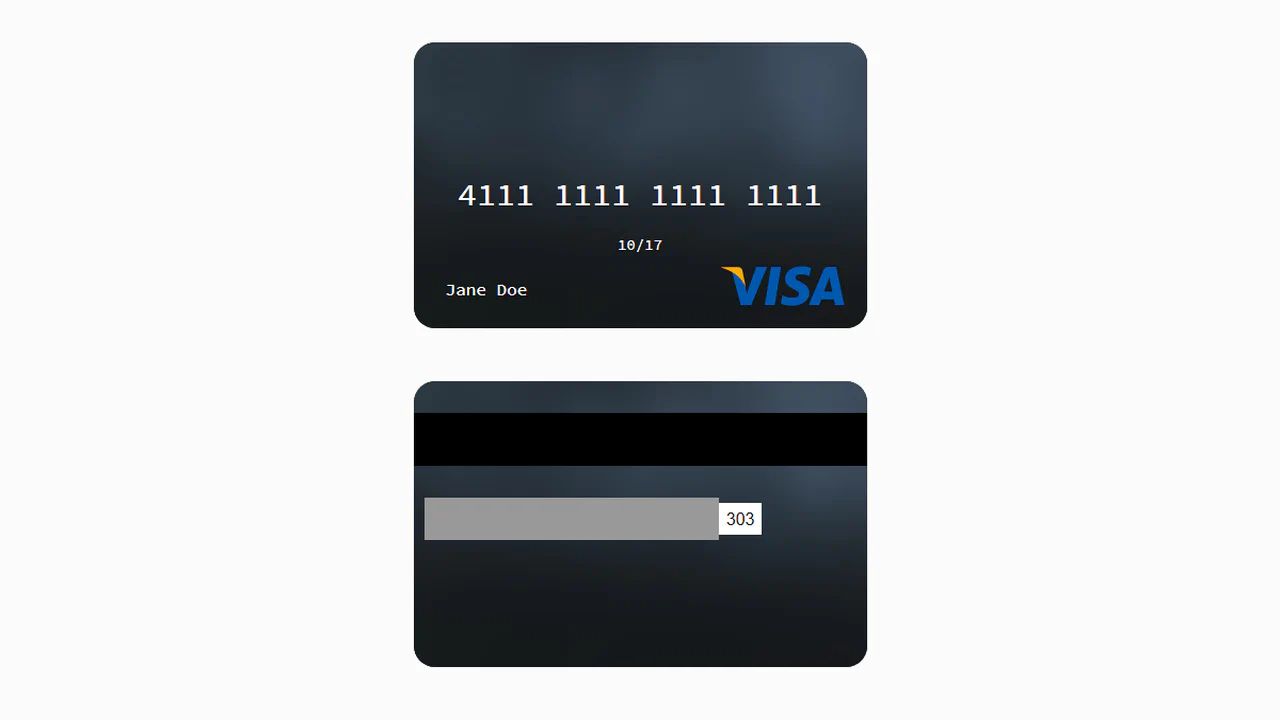
Credit Card Template
A static credit card layout with a clear separation of front and back sides - a ready-made template demonstrating styles and a component-based approach without any JS logic.
See the Pen Credit Card Template.

HTML and CSS Credit Card
A pure CSS illustration of a credit card, where the entire structure is organized via LESS variables and mixins, and complex visual effects - from background curves with asymmetric border-radius to the embossed text using content: attr(title) - are implemented exclusively with pseudo-elements.
See the Pen HTML and CSS Credit Card.
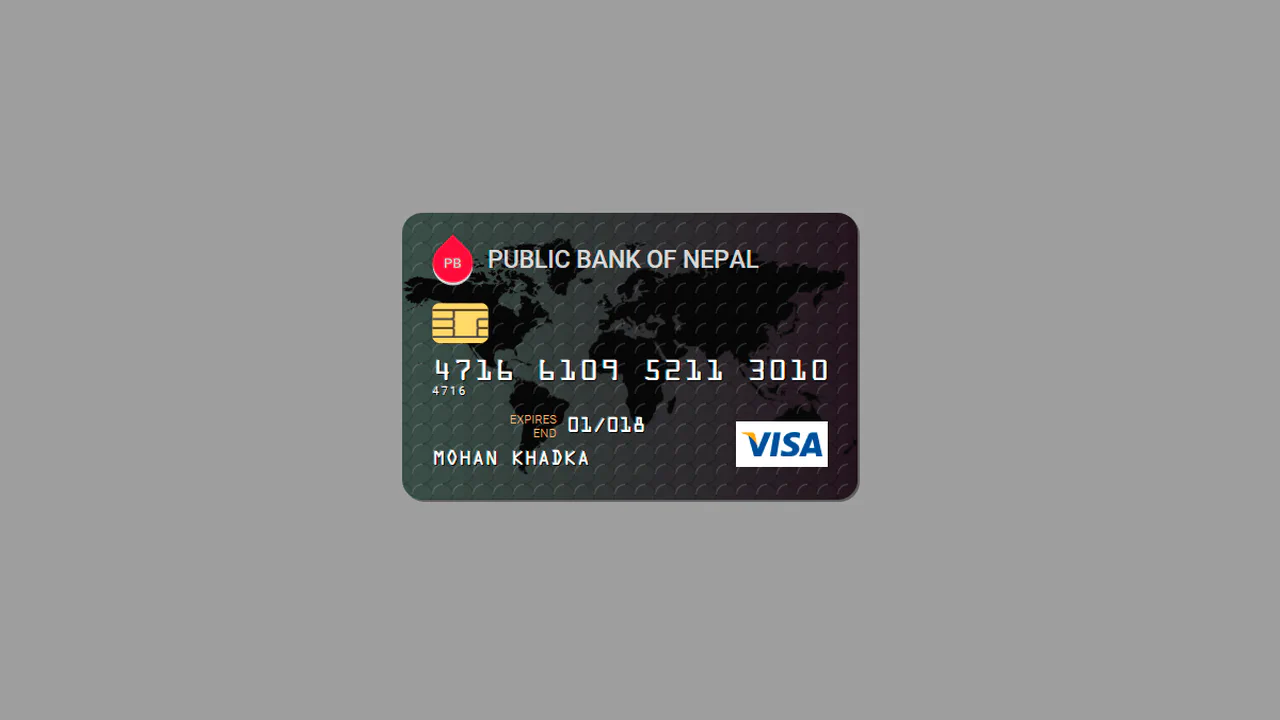

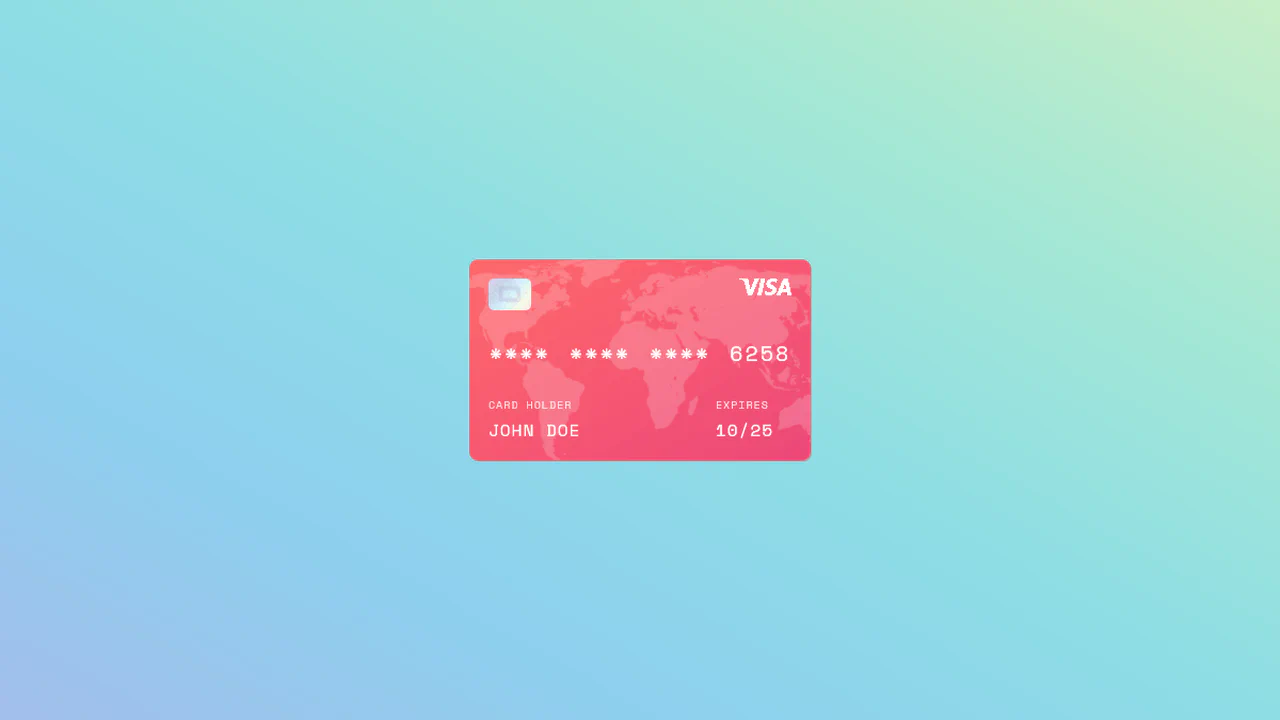
A static credit card interface. Visual layers — a world map backdrop, circuit-like SIM icon, and Visa logo — are composed to suggest a physical card. Typography uses a monospaced font for data fields, reinforcing the functional aesthetic.
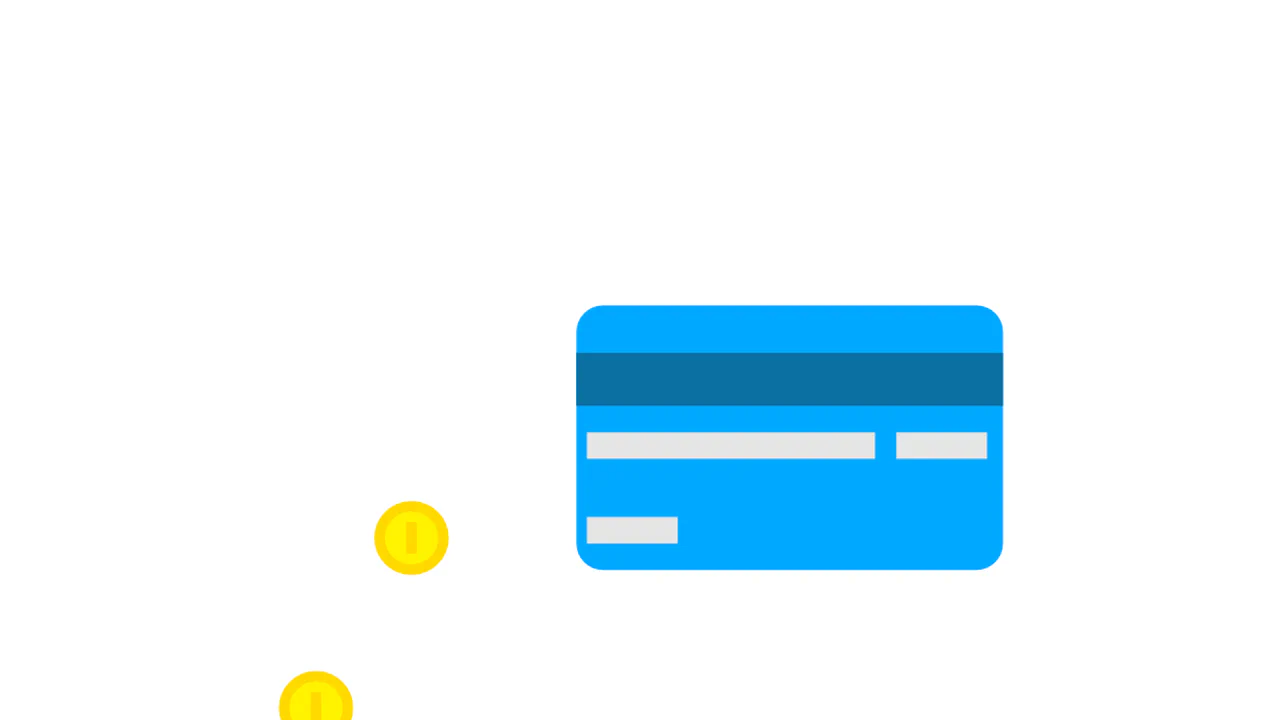
Credit Card Animation
A looping SVG animation of falling coins and a sliding credit card. Coins drop at staggered intervals, creating a sense of weight and varied rhythm. The card slides horizontally with a bouncing motion.
See the Pen Credit Card Animation.

A credit card mockup with embossed text and a holographic element. The gradient background shifts to suggest light reflection, while layered text shadows create a raised, stamped effect. A separate animated gradient simulates a hologram.

Credit Card
A credit card interface built with layered SVGs and gradients. The geometric background provides depth, while the gold chip and white logos establish contrast.
See the Pen Credit Card.
Flipping Credit Card
A 3D credit card built with CSS transforms. The front and back are separate layers; a hover trigger rotates the card to reveal the CVV and magnetic stripe.
See the Pen Flipping Credit Card.

Nubank Credit Card
A credit card mockup built entirely with CSS. The chip is constructed from overlapping semi‑transparent shapes, and the holographic globe pattern uses repeating linear gradients.
See the Pen Nubank Credit Card.

3D Floating Credit Card
A 3D credit card built with CSS transforms and JavaScript mouse tracking. Multiple thickness layers create depth, while SVGs render logos and contactless symbols.
See the Pen 3D Floating Credit Card.

Credit Card Grid Layout
A credit card interface built with CSS Grid. The layout is defined by explicit grid areas — each element occupies its designated cell.
See the Pen Credit Card Grid Layout.

Pure CSS Credit Card
A 3D credit card built with CSS transforms. Two separate faces — front and back — flip on hover, revealing the CVV and terms on the reverse.
See the Pen Pure CSS Credit Card.
CSS Credit Card with Flip
A 3D‑flip credit card. Two faces rotate on hover, revealing the signature and CVV.
See the Pen CSS Credit Card with Flip.

Glassmorphism Credit Card With HTML & CSS
A pure CSS glassmorphic credit card layout. The design positions a semi-transparent frosted card container over two static background spheres styled with radial gradients. Using backdrop-filter: blur(5px) and a translucent white border, the card seamlessly distorts the colors underneath, yielding a classic glass-plate effect.
See the Pen Glassmorphism Credit Card With HTML & CSS.
Virtual Credit Card Design
An interactive, double-sided 3D credit card built with pure CSS. The container uses perspective: 1000px and preserve-3d to rotate the inner faces 180 degrees on hover. Using backface-visibility: hidden and absolute positioning, the card flips smoothly to reveal a detailed back complete with a magnetic strip, CVV, and signature.
See the Pen Virtual Credit Card Design.
Responsive, Glittery Bank Card
An interactive holographic credit card styled with pure CSS. The container tilts infinitely on the X and Y axes in 3D space. Simultaneously, a pseudo-element blends a glitter PNG background with a sliding linear gradient using mix-blend-mode: color-dodge to create a realistic, shimmering metallic sheen across the card surface.
See the Pen Responsive, Glittery Bank Card.
SVG Debit Card Animation #4
An interactive vector debit card built with SVGs and animated via GSAP. It utilizes the motionPath plugin to guide sliding polygon triangles along concentric dashed coils. Simultaneously, masking filters, shifting gradient wavy backgrounds, and staggered text translations create a fluid layout that replays on click.
See the Pen SVG Debit Card Animation #4.