1 CSS ::details-content Examples
Hierarchical content demands structure without DOM bloat. The CSS ::details-content examples in this collection remove the need for extra wrapper divs, allowing raw logic to style the expandable area of the HTML <details> element directly. Utilizing these curated snippets ensures a seamless transition from hidden to active states, bridging the gap between data and the screen instantly.
Technically, the ::details-content pseudo-element targets the inner content box of the native <details> element, giving developers direct styling access where wrappers were previously required. The code combines this with interpolate-size: allow-keywords and grid-template-rows to animate container height — a performant alternative to manual pixel counting. Transitions leverage hardware acceleration, animating properties like opacity and transform to maintain a locked 60fps performance during expansion. By offloading styles to this pseudo-element, the design remains lightweight and optimized for rendering engines, preventing unnecessary repaints.
Every free demo is fully responsive and cross-browser compatible. Users can instantly download the raw code or fork an updated interaction on CodePen. These assets prioritize performance, providing a fast, frictionless UI experience across all modern mobile and desktop devices.
Examples
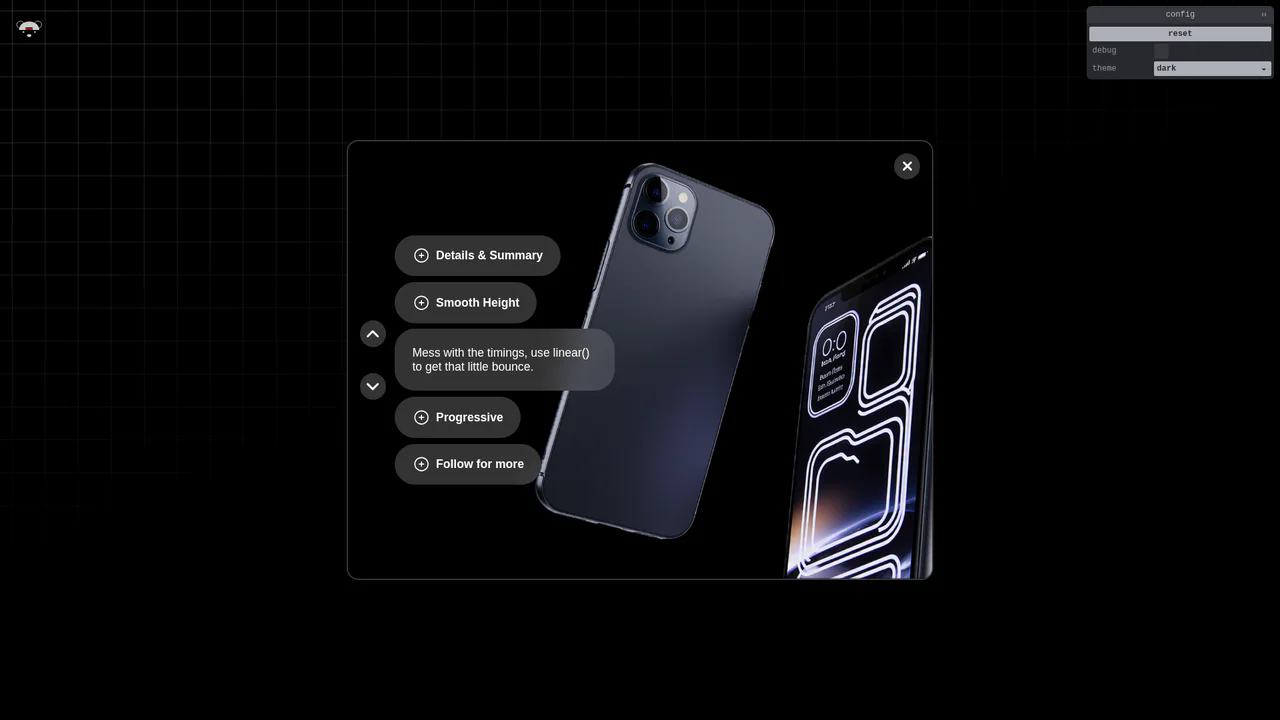
Smooth Accordion with Parallax Images
An advanced semantic accordion using native <details> elements synchronized with a parallax image gallery. Height transitions are made fluid through modern interpolate-size: allow-keywords and complex linear() bounce easings. JavaScript connects active toggles to external navigation buttons, aligning the active image block to match disclosure states. (Requires: gsap.js, tweakpane.js)
 Chrome 129+
 Edge 129+
 Firefox 121+
 Safari 17.2+
See the Pen Smooth Accordion with Parallax Images.