10+ CSS Dividers
Space dictates structure. CSS dividers separate content zones cleanly, removing visual clutter between data and the screen. This updated collection provides raw, minimalist separators for modern UI design. Utilizing these curated snippets eliminates redundant styling. Focus on data flow, not calculating exact spacing from scratch.
These examples rely on Flexbox and pseudo-elements (::before, ::after) for precise line alignment. SVG masking creates organic layout breaks. Micro-interactions leverage hardware acceleration, animating properties like transform and opacity. This ensures a 60fps frame rate without reflows. The HTML structure remains strictly semantic, maintaining high layout stability and fast rendering.
Every free demo is fully responsive and cross-browser compatible. Users can instantly download the raw code or fork a shape on CodePen.
Examples
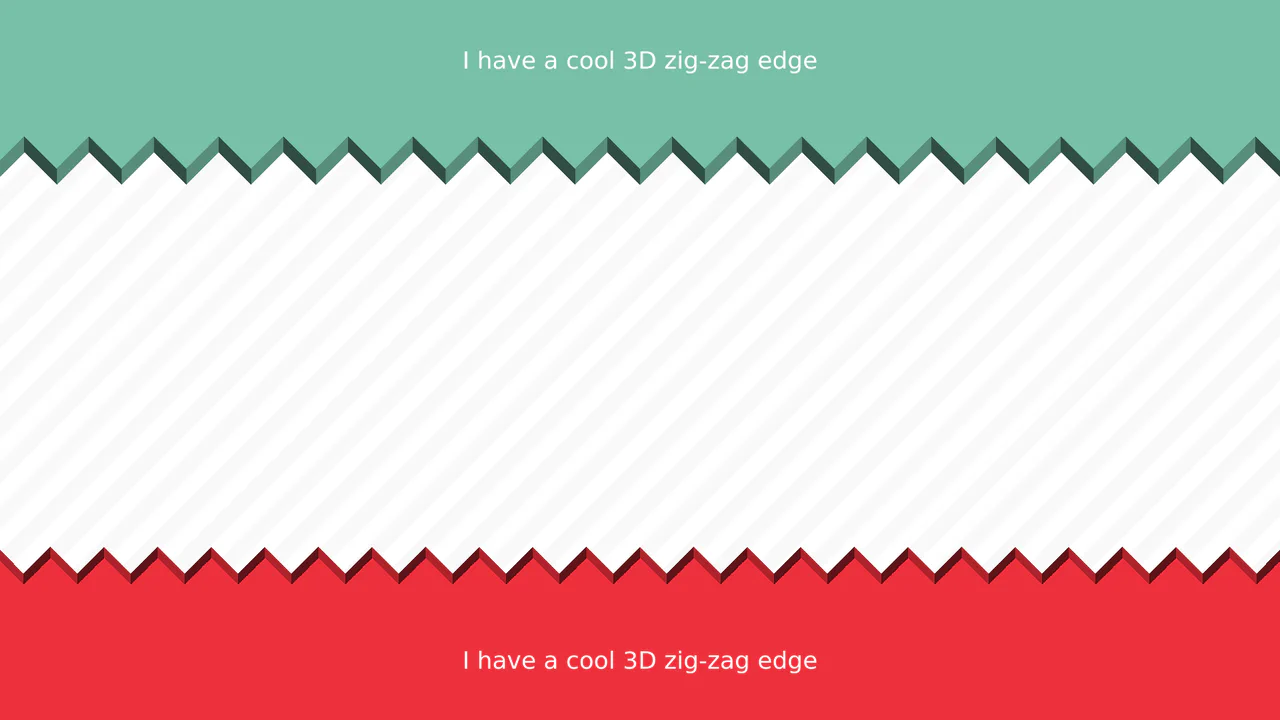
3D Zig-Zag Edge CSS Dividers
3D Zig-Zag Edge CSS Dividers creates a paper-cut illusion using only CSS. It relies on conic-gradient applied to both the background (for shading) and -webkit-mask (for the jagged shape). CSS variables control the size and depth of the teeth. This approach requires zero extra DOM elements or SVG files, making it a highly optimized solution for section transitions.
 Chrome 69+
 Edge 79+
 Firefox 83+
 Safari 12.1+
See the Pen 3D Zig-Zag Edge CSS Dividers.

Dynamic Diagonal Layouts
This is a Dynamic CSS Diagonal Layouts component. It demonstrates how to create striking, angled section dividers without relying on bulky SVG backgrounds or brittle magic numbers. Its function is to provide a mathematically precise, responsive framework for creating non-rectangular web layouts using modern CSS trigonometric functions (tan()) and pseudo-elements.
Chrome 111+
Edge 111+
Firefox 108+
Safari 15.4+
See the Pen Dynamic Diagonal Layouts.

Stacked Wave Dividers
Generation of wavy dividers using a Sass function that calculates points for clip-path via math.sin. The layout is dynamically inverted via the --p CSS Custom Property, which simultaneously controls element order and the color scheme through color-mix(), while negative margins ensure seamless section overlapping.
See the Pen Stacked Wave Dividers.


A collection of separator styles for horizontally dividing sections on a website. The dividers are created using several techniques, including styling pseudo-elements, using gradients and inserting SVG graphics with responsiveness in mind.

Rainbowy Dashed Divider
A creative divider made by layering two pseudo-elements - an animated rainbow gradient and a masking dashed line that “punches” holes in it using a linear-gradient.
See the Pen Rainbowy Dashed Divider.

Scalloped section divider via radial gradient. Repeating background forms semicircles, creating serrated edge. Two variants (scallop-up/down) change gradient position — top or bottom.

Diagonal dividers via linear gradient. Two directions (to left bottom / to right bottom) create beveled edge between sections. Gradient with 49% and 50% forms sharp color transition boundary.
Collection of SVG dividers for sections. Each separator built from polygons with color layers creating depth and shadows. Positioning via preserveAspectRatio and transforms enables scaling without distortion.
Full-screen slanted sections via skew transform. Each section skewed by -4.76°, inner content returned to horizontal with reverse skew. translateY and min-height compensate geometric offsets, last section has no skew and overlaps previous one via z-index.
Sections with wavy SVG separator at the joint. Bottom of .section-one contains absolutely positioned svg with two paths creating 3D overlap effect on .section-two. On mobile, separator rotates and expands to maintain visual overlap.
Animated wave from SVG sprites with parallax effect. Four layers (parallax1–parallax4) move at different speeds and opposite directions, creating depth illusion. Animation infinite with negative delays for continuity.

Decorative hr with three dot elements from SVG data. Center dot is round, left — teardrop shape, right — square. All elements embedded via background-image without extra requests.

Theming system via CSS variables and data-theme attribute. Two themes (dark and softSecondary) define complete color palette with shades. SVG divider dynamically inherits next section’s background color via var(--color-bg).
Sections with bubble separators via inline SVG in :after. bubbles mixin generates two wave types (a or b), color dynamically injected via url-friendly-colour. Separator colored with current section color and overlaps next one.

Decorative hr with animated icons on sides. Two pseudo-elements (:before and :after) contain inline SVGs with different animation delays, creating chasing effect. Background position shifts in infinite loop.


