10+ CSS Masonry Layouts: Free Code Snippets & Examples
CSS masonry layouts organize asymmetric, variable-height grid items into seamless, Pinterest-style columns, eliminating horizontal blank spaces without requiring heavy DOM math. By packaging native column and grid structures, these templates deliver fluid image galleries and responsive dashboard feeds with pristine visual economy.
- Modern engines compile native interlocking grids using experimental grid-template-rows: masonry declarations, aligning item heights dynamically within a single stylesheet rule.
- Lightweight, highly performant multi-column fallbacks utilize the native CSS columns property, flowing content sequentially down vertical spans with zero script calculation.
- To preserve INP (Interaction to Next Paint) performance during heavy rendering states, complex grid item translations are handled strictly on GPU compositor layers.
Explore these responsive card grids to master the integration of fluid, asymmetric multi-column layouts and native masonry styling into your web platforms.
Table of Contents:
Examples
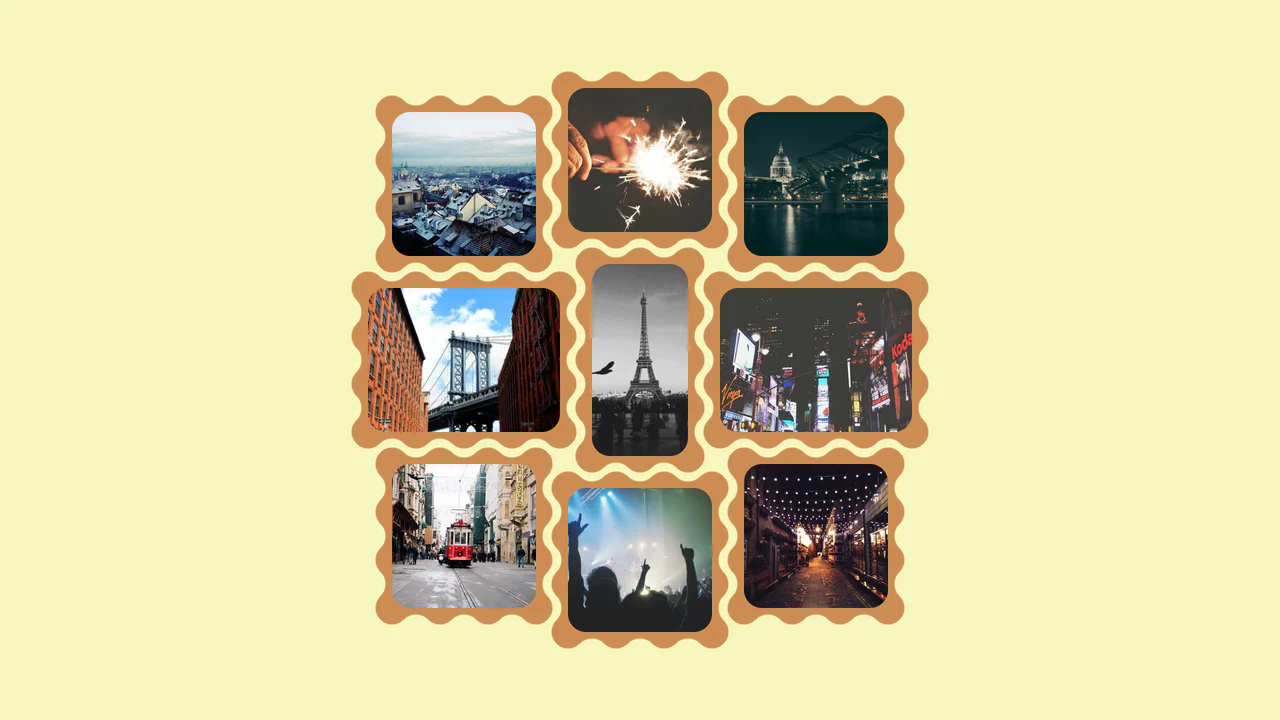
Interlocking Wavy Image Grid
This is an Interlocking Wavy Image Grid. It applies procedural scalloped edges to raster images and shifts them into a tight, puzzle-like masonry formation. Its function is to break rigid, rectangular bounds in visual galleries, converting standard blocks into an organic, cohesive texture.
 Chrome 111+
 Edge 111+
 Firefox 112+
 Safari 15.4+
See the Pen Interlocking Wavy Image Grid.

Grid Lightbox Gallery Effect
This is a CSS Grid Lightbox Gallery Effect. It structures an asymmetric image grid that expands individual photos into a full-screen, blurred overlay upon interaction. Its primary function is to focus user attention on a single visual asset while maintaining the context of the underlying page through transparency.
Chrome 76+
Edge 79+
Firefox 103+
Safari 13+
See the Pen Grid Lightbox Gallery Effect.

CSS Scroll-Driven Masonry Reveal
This Scroll-Driven Masonry Reveal creates a playful, tactile experience where content cards appear to be “dealt” onto the screen as the user scrolls. By leveraging the native CSS Scroll-driven Animations API, it achieves smooth, main-thread-free entrance effects without a single line of JavaScript. The layout adapts intelligently from 2 to 8 columns, making it a robust solution for image galleries or blog archives. (Requires: Open Props (CSS Library))
Chrome 115+
Edge 115+
Safari 26+
Firefox (flag/polyfill)
See the Pen CSS Scroll-Driven Masonry Reveal.

Animated Portfolio with SVG ClipPath Hover Effect
This interactive portfolio showcases a masonry-style layout built with two overlapping CSS Grids, where grid-row: span and grid-column: span create the complex pattern. The key interaction is a unique “spotlight” reveal effect on hover, powered by a JavaScript-controlled SVG <clipPath> that dynamically updates the position of a <circle> mask to follow the mouse.
See the Pen Animated Portfolio with SVG ClipPath Hover Effect.
CSS Thumbnail Transition Effects
A fluid, responsive gallery that automatically adjusts to screen size and provides rich visual feedback on hover.
See the Pen CSS Thumbnail Transition Effects.
CSS Masonry
A responsive masonry-style image gallery constructed using CSS floats and media queries to manage varied tile dimensions.
See the Pen CSS Masonry.
CSS Grid Masonry
A dense, neat grid of cards with varying heights (Pinterest-style) that correctly rearranges upon window resizing and content loading.
See the Pen CSS Grid Masonry.
Pure CSS Masonry Gallery with Flexbox
Responsive Flexbox gallery with column count changing (3 → 2 → 1) via media queries. Hovering the container dims all images, individual item highlights. Titles absolutely positioned over pictures.
See the Pen Pure CSS Masonry Gallery with Flexbox.
Responsive Pure CSS Masonry Layout
Responsive CSS multi‑column masonry with variable‑height tiles. Media queries adjust column count, pseudo‑elements show a counter and an emoji, background color and hover controlled by an SCSS mixin. Minimal yet flexible structure without images.
See the Pen Responsive Pure CSS Masonry Layout.
True Masonry with Grid Layout
Responsive CSS Grid with grid-auto-flow: dense and span-* classes to create tiles of varying sizes. repeat(auto-fill, minmax(180px, 1fr)) automatically adjusts column count, while dense flow fills the gaps. A simple yet clear demonstration of Grid capabilities.
See the Pen True Masonry with Grid Layout.
Easy Horizontal Masonry Effect with CSS Grid
Vertical page orientation (writing-mode) creates an unusual reading grid. Horizontal quote tiles are arranged in a CSS Grid with dense auto‑placement. span-* classes control item height, media queries adapt the grid to screen height.
See the Pen Easy Horizontal Masonry Effect with CSS Grid.

Masonry Dynamic Column Flexbox
Fixed‑height flexbox container with column wrap. Every sixth item has a predefined height, creating a mosaic rhythm without media queries. JavaScript adds/removes cards and inserts random images.
See the Pen Masonry Dynamic Column Flexbox.

Photo Gallery
CSS multi‑column gallery (columns). Images and captions automatically flow into 200px‑wide columns. Hover removes grayscale and changes border color. Minimal code with no media queries.
See the Pen Photo Gallery.


Responsive image grid with CSS Grid using auto-fit and a minimum column width of 250px. Classes .wide, .tall, and .big let specific items span more space, creating a mosaic layout. Images are fitted into cells with object-fit: cover.

Masonry Layout with CSS Grids
Masonry‑style layout using CSS Grid with fixed rows and manual cell placement. Images adapt to cells via object-fit: cover. No JavaScript — just Grid and explicit coordinates.
See the Pen Masonry Layout with CSS Grids.

Masonry-Style Layout
A technical comparison of layout modes. Showcases experimental native Masonry vs. Grid, Flexbox, and Multi-column. Uses radio toggles with the ~ selector — no JavaScript. Employs auto-fill and gap for fluid sizing. Focuses on tight packing while preserving source order. Functional, minimal, and browser-forward.
See the Pen Masonry-Style Layout.